Friday, June 25, 2010

Building the Platform


In the past, we've discussed the importance of building an author's platform, getting your name and work out there. It can be a chore at times, posting on Facebook, Twitter, blogs, etc. During the writers conference last week in Vegas, I discovered a tool that allows you to post to all these sites simultaneously. The website is: http://ping.fm/ It's a free service that makes updating your social networks a snap. I've begun using it; it's a time-saver--give it a try.

Wednesday, June 23, 2010

Grandson Colin scored again in hockey--I missed it--I'm in NY :-(

Monday, June 21, 2010

Thriller or Mystery?


I just spent three days in Vegas at the Public Safety Writers Convention. It was a great opportunity to meet with fellow authors and columnists from around the country. I also appeared on two panels, one of which had four of us discussing the difference between a thriller and a mystery. One of the panelists was best-selling author, Simon Wood, whose new novel, Terminated, has just released.


We all agreed that the basic difference between the two is simply this: a mystery begins with the crime or main event happening immediately, and what follows is the effort to solve it. The thriller, on the other hand, is structured in such a manner so that there is an ever-increasing crescendo of action that culminates at the end with the big event or crime. It's somewhat akin to a roller coaster ride, with highs and lows, but nonetheless, the climax comes at the end.


I was thoroughly pleased with the conference. I learned several things that I'm sure will enhance my writing in the future. One thing which was reinforced for me was the importance of a critique group. I am thankful for our own Riverside Writers group that meets at Borders. Thanks to all who have helped me in the past. I'll be sharing some other topics from the conference in future posts.

Sunday, June 20, 2010

Grandson Colin's hockey team won today; he scored! Great Fathers Day gift.

Thursday, June 17, 2010

It Is A Learning Experience


Getting a book published is a journey. Some may experience a longer trip than others, but all who travel the publishing road will have many things in common. I came across a good article on the topic in which Alan Orloff describes: 7 Things I've Learned So Far. Take a look at it, it's worth reading whether or not you're published. Items two and six, rang true or me. Number two talks about getting help from critique groups, editors, etc, while item six reinforces what I've learned: other writers are extremely generous in helping new authors with time and advice on a myriad of subjects that will help the newbies reach their goal of becoming published.

Tuesday, June 15, 2010

The Importance of Reading


Do you want to become a good writer? If the answer is yes, then it's important that you become a good reader first. Whenever I appear on an authors' panel, or speak to a group about writing, I stress the importance of reading. This simple pleasure is an invaluable tool that allows a writer to learn the many skills needed to write, whether it be fiction or non-fiction.


The key to learning from reading is to read with a critical eye--try to discover the techniques the author uses to get the reader involved in the story. How does he develop his characters, what point of view does he use to draw the reader in, and does he use language that makes the story credible and believable? Look for these teaching points when you begin your next book. Here's a link to an excellent post on the same topic: Book Publishing News.

Sunday, June 6, 2010

Top Ten Ways NOT To Improve Your Writing


I came across an excellent posting by Jodi Wisenhunt about the top ten ways NOT to improve your writing. Since it's such a complete and concise list, I'd like to share it with those of you who follow my blog. Here's the link: Aim For Perfection Editing.

My favorite on the list (and also a pet peeve) is number seven:

7) Use cute little "catch phrases" and be sure to place quotation marks around them so the reader "gets" it.

Read the list to see if you find yourself involved with any of the "no-no's."

My thanks to Ms. Wisenhunt.

Saturday, June 5, 2010

Hooking A Reader


If you're like most of us who shop for books, the first thing you do is open the book to the first chapter and read the first sentence. More often than not the first few sentences or paragraphs will serve to aid your decision to buy the book or not. That means your opening sentence is probably the most important one in your book. It has to "hook" the reader, drawing him in with excitement, or perhaps shock, wanting the reader to know more about the story.


As an example, I offer the first paragraph of my second novel, Gripped By Fear:


It was done. He stood and fastened his pants, then became one with the darkness as he slipped out the door and into the alley. This time of night welcomed only demons and devils. It was good, but not nearly enough. He would need more . . . soon.


For more on the importance of your first sentence, read this post: On Writing: A Tate Publishing Blog.

Friday, June 4, 2010

You Are Your Own Best Publicist

I'm at the doctor's office this morning, reading my Kindle as I await my turn to be seen. A woman is leaving and sees me, she asks, "Is that a Kindle?" I reply that it is, and a conversation ensues in which we discuss e-readers (she has a Barnes & Noble Nook e-reader).

Being always prepared, I hand her one of my bookmarks which contains information about both my novels. I tell her that it's available on Kindle and other readers; she is interested and reveals that she manages the B & N in Alexandria. A few moments later we agree to arrange a book signing.

The bottom line of this chance meeting? No one can market you, better than you. Always be prepared to sell yourself and your work.

Thursday, May 27, 2010

Debut Author Herm Groman

JW: Former colleague, and now fellow-author, Herm Groman is my special guest blogger today. Herm, we spent ten years together in the Detroit Division of the FBI, all of which helped cement the special bond we share today. Your first book, Pigeon Spring, debuts this month. Give our readers a thumbnail sketch about your background.

HG: What a great ten years it was too! I know this might sound a little weird, but Detroit was the most exciting city we could have been assigned to at the time. Being an FBI Agent there exposed us to the best criminal work that an FBI Agent could hope for. I got transferred to Detroit from the Pittsburgh office in 1982 and was first assigned to an organized crime squad, then to a drug squad, and finally to a public official corruption squad. During all three of those assignments, I was fortunate to work a lot of undercover operations and major cases. Then I went to the Las Vegas FBI office where once again I went undercover on several major organized crime and public official corruption cases. When I retired five years ago, I was on the Special Operations Team. This was post 9-11, so we did a lot of work related to terrorism all over the country.

JW: What prompted you to write a novel, it seems a rather ambitious beginning to a writing career? Why not start with a short story to get your feet wet?

HG: Good question John. The answer is I fell in love. I fell in love with rural Nevada, its people, the history, and the landscape. I already loved Las Vegas, but there really are two Nevadas. I wanted to tell a story about both of them. I guess it’s a lot like any large project. You think you know where you are going with it, and before you know it, it develops a life of its own. It was a labor of love.

JW: You’re Chief of Security at a major casino in Las Vegas, which had to play a huge role in your book. Tell us how that impacted your story.

HG: It does play a major role in the novel. As you know from having the good fortune to have served as an FBI Special Agent, we were exposed to an incredible number of real life situations and characters that serve as a basis for great stories. The casino business is the same target-rich environment for these wacky colorful stories. I couldn’t make up some of this stuff. My imagination isn’t that good. But it doesn’t have to be; real life is so much more entertaining.

JW: I know the excitement and emotion I felt when I saw the finished product for my first book. Share with us what your feelings when you opened the box and saw Pigeon Spring for the first time.

HG: The closest I can come to describing it is, it’s like Christmas morning and Santa just left the house. I still go to Amazon.com at least once a day and just stare at the book cover and shake my head. To say it’s exciting is an understatement. Today some guy came into my office at the casino with six books he purchased and asked me to sign them. It’s a blast!

JW: I know the book is a mystery, but without giving away too much of the story, tell us what Pigeon Spring is about.

HG: It’s largely set in rural Nevada, but the story takes the reader from the glitz, glamour, and scams of a Las Vegas casino to the serene beauty of the Sierra Nevada where retired FBI Agent Matt Steel encounters someone from his past. The story has a mystical twist to it as well. I like to think there is something for everyone in the book. There’s action, mystery, history and a surprise ending in which an ancient Native American artifact plays pivotal role.

JW: I suspect we may see some Herm Groman traits in your protagonist. With all of your undercover experience, does your book’s character get involved in that work as well?

HG: I couldn’t keep him out of it. The undercover work comes out in a big way, but Matt Steel isn’t the Hollywood stereotypical flawed protagonist. You know…the drunken divorced retired cop who drives like a maniac. I don’t know about you, but I’m tired of that guy. He’s predictable and boring. Matt is an honest straight forward guy with a sense of humor. You know he’s a good guy right away, but I think readers will find him to be an interesting character with a few tricks up his sleeve.

JW: Sounds fascinating, Herm. What are your plans after Pigeon Spring, perhaps a sequel?

HG: I’ve really learned a lot about the writing process this past year. I’m taking that experience and moving forward with a sequel. I feel like I’ve found a place for Matt and the characters he encounters at the casino and rural Nevada. Both places are a rich and diverse source of colorful stories and I enjoy blending them together. This next one starts off with the bribery of an unnamed politician, the murder of a prostitute, and centers around a nuclear waste repository in rural Nevada.

JW: Thanks for being a guest on my blog. For those of you interested in Herm’s work, you can go to his website: www.hermangroman.com/about/about.htm. I took a look at your site, Herm . . . you have plenty of signings and appearances lined up. For those who can’t make it to Vegas, I know your book is available online at Amazon, Barnes & Noble, Books-a-million, and of course through your publisher, TotalRecall Press. Good luck, my friend.

Wednesday, May 26, 2010

What Is A One-Word Sentence?

Can one word be a sentence? Can I use one word for emphasis? Find out here: A one-word sentence.

Tuesday, May 25, 2010

Your First Book Signing


Let me disabuse some of you of the notion that once you've been published, it's smooth sailing afterward. Take a look at this video and please leave comments: Signing In Walden Books

Thursday, May 20, 2010

Don't Get Sidetracked


You're writing and things are moving along, your muse is alive and operating on all cylinders. And then it happens--you get to a point where you're not sure about something . . . an address, a date, something that needs to be researched a little. Do you stop and look it up?
Here's a practice that has worked for me: simply type, in all caps, the words MORE INFO after whatever it is that needs verifying, and then move on. You can return later and do whatever needs to be done, but don't stop the flow of ideas, particularly when they're running downstream like a twig in a strong current.

Tuesday, May 18, 2010

Rejection Letters


It's not easy to accept a rejection letter. Every writer feels the same, that they've done their best and polished their manuscript to the point of near perfection. To have your work rejected by publishers pains even the strongest of us. But all is not lost. Follow this link to discover that you are not the only one to suffer this indignity: Famous Rejections.


Strangely, it comforts me to know that an author such as John Grisham, had his novel, A Time to Kill, rejected by 16 publishers before finding an agent who eventually rejected him as well.

Friday, May 14, 2010

Do I Need A Literary Agent?

The short answer is: maybe. There are publishers who won't even give your query letter a look, if it hasn't been submitted by an agent. If you are a new author who doesn't know his way around the publishing industry, having an agent is probably a wise idea, and here are a few reasons why:
  • they know which publishers to contact, which saves you from sending out useless inquiries
  • they work to sell your book to a publisher, since they don't get paid unless your proposal is sold
  • they ensure your proposal is solid and powerful, and will work with you if it's not

Where do I look for an agent? There are a number of publications in print: Writers Digest Guide to Literary Agents, Writer's Guide to Book Editors, Publishers, and Literary Agents, are two places to start. And there are numerous sites online, the best is the Association of Authors' Representatives (AAR). If your agent is not a member, continue your search.

Here's a link to an excellent article by Bobbi Linkemer, herself an author of 14 books, an editor, ghost writer, and book writing teacher: WHAT EVERY AUTHOR SHOULD KNOW ABOUT LITERARY AGENTS.

Wednesday, May 12, 2010

Character Development


If you're writing a novel that involves many characters, how do you keep track of them? What does each one look like, habits, dress, family history, etc., these are things which can slow you down, just when you get rolling on a chapter. One way to solve the problem is to maintain a character chart. Here's a link to a blog with a free downloadable chart: Character Chart.


It's quite a comprehensive one to be sure,and it's a bit too lengthy for my tastes. When I start a novel, I have a general idea of who the characters will be and their role. Then as I get into the story, I flesh them out, depending on what the story dictates. As I develop them, I write down new traits, or characteristics, idiosyncrasies, etc., and when I'm finished writing, I go into a Word document, named "Characters." I keep a bulleted list of each character, briefly describing them and their background. Whenever I need to add another dimension, I simply go to the document and add another bullet.


It works for me, but if you're having a problem with keeping your characters straight, particularly if you haven't worked on the piece for a while, reading your character chart is a quick way to refresh you memory.

Tuesday, May 11, 2010

What's An ISBN?


The International Standard Book Number (ISBN) is a 10-digit number that uniquely identifies books and book-like products published internationally. The number identifies a title, or an edition of one, and allows booksellers, libraries, and book wholesalers and distributors an efficient way to market books.

The ISBN consists of ten digits, divided into four parts, each separated by a hyphen. It is unique to the book to which it is assigned, identifying it as: large print, trade paper, hardcover, audio CD, downloadable audio, Kindle e-book, Sony e-reader, etc. Without an ISBN, book stores, especially online, would not know what the customer is actually ordering.

If your book has an ISBN, make sure you get it listed in BIP (Books In Print). R.R. Bowker runs the US ISBN Agency. It licenses BIPs to Barnes & Noble, Borders, libraries, and the top three search engines. Without an ISBN, your book will not automatically appear in searches like Google. Then you're left to your own devices, your own marketing expertise, to get your book out to the people.


ISBNs are a gateway to marketing; not having one is like knocking on a door and getting no answer.

Saturday, May 8, 2010

Sometimes Smaller Is Better


Many writers would love to have the opportunity to choose between a large publisher and a small one, or an independent, as they're called. So which one is better? Each has their own unique capabilities and each will accomplish the same thing: get your book out to the reading public.


This year's Pulitzer Prize winner in fiction can tell you that bigger isn't always better. Here's his story: Is bigger always better? It's an interesting read, one that gives hope to those who are working with small, independent publishing houses (I'm one of them).


One of the the things that struck me while reading the insightful interview was how the author built his platform, something we've been discussing on my blog. Public appearances, book signings, Internet presence--they all add up to develop readers who are loyal to you and your work. Check out the link, it's good stuff.

Tuesday, May 4, 2010

Basic Mistakes


We all make them, mistakes that seem obvious . . . afterward. As the words are flowing and ideas are popping in our head like kernels of corn floating in hot grease, we fall into them, naturally. Writer's Digest came up with a short list of 8 Basic Writing Blunders. I could add to the list, but at the risk of embarrassing myself, I'll pass only these eight on to you. It's good stuff; a great reminder about how important it is to be concise and not over-state the obvious.

Monday, May 3, 2010

Ever Read A Publishing Contract?


I'm not a lawyer, I don't even play one on TV, but it almost takes one to decode some of the language in publishing contracts. If you're fortunate enough to be offered a contact, here's a good source to take a look at before you sign: Rachelle Gardner's Literary Agent website.

ShareThis

Get My Books On Kindle!

Watch a book trailer for TARGETED!

Chicago Warriors Thriller Series

Watch a trailer for Gripped.

My Shelfari Bookshelf

Shelfari: Book reviews on your book blog

Gift Store

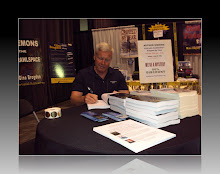
SIBA Signing

SIBA Signing

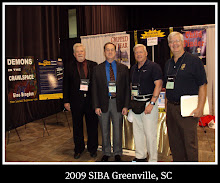
TotalRecall at SIBA

TotalRecall at SIBA

Debut Novel